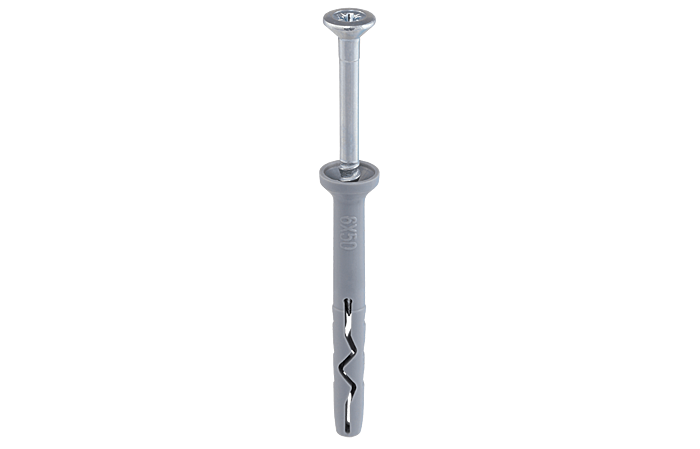




Hammer drive plug SM/SMN comprises a polyethylene or polyamide sleeve and a countersunk head screw made of electroplated coatings or non-electrolytically applied zinc flake coatings steel. It is designed for fixing of wood and wood-based members. Increased head diameter ensures much better holding power of the elements being installed, and countersunk section provides reliable installation and eliminates damage to the screw when driving. Types of substrates on which hammer drive plug SM/SMN can be installed: âĸ Normal concrete (use category A) âĸ Solid masonry (use category B) âĸ Hollow or perforated masonry (use category C) âĸ Lightweight aggregate concrete (use category D) âĸ Autoclaved aerated concrete (use category E)Method of installation:1. Before installation identify a substrate in which the plug will be installed and compare loads which the plug will carry to resistance values given in Product Data Sheet or European Technical Assessment 2. Select an adequate length of the plug so that expansion zone is in the construction material of the wall (thickness of member being fixed matches max. usable length of the plug â tfix) 3. Use proper method of drilling according to a substrate type (holes in masonry substrate made of autoclaved aerated concrete blocks should be drilled using a drill without impact) 4. Diameter of drilled holes should match diameter of the plugs used 5. Drilled holes in substrates of solid materials should be deeper by min. 10mm compared to the plug anchorage depth 6. Clean the holes in solid materials of drillings with a back and forth motion of the drill at a reduced speed 8. Then insert the plug into a drilled hole, and drive the screw until it completely penetrates the sleeve
Expand the full description
FAQ
Welcome to polystyrene insulation EPS boards FAQ! Here you'll find answers to our most asked questions. Still can't find quite what you're looking for, or have something we should know? Use Q&As section or send us an email, we're happy to help!
Q1: What are EPS polystyrene boards used for in external wall insulation?
A1: EPS (Expanded Polystyrene) boards are used as thermal insulation in External Wall Insulation (EWI) systems. They are mechanically fixed and adhesively bonded to external walls, then reinforced with basecoat, mesh, and decorative render to improve energy efficiency and façade appearance.
Q2: Is EPS insulation good for external walls?
A2: Yes â EPS is one of the most widely used façade insulation materials because it offers: - Excellent thermal performance - Lightweight handling - Cost efficiency - Easy cutting and installation - Compatibility with most render systems
Q3: What thickness EPS boards are used for EWI?
A3: Common thicknesses in the UK: - 50 mm â minimal upgrade - 70â90 mm â standard retrofit - 100 mm â popular energy upgrade - 150â200 mm â low-energy / passive targets Thickness depends on U-value requirements and building regulations.
Q4: What is the thermal conductivity (Lambda) of EPS?
A5: Standard white EPS is Euroclass E (combustible). However: - It is always encapsulated within render systems. - Fire-retardant grades are used. - System fire ratings depend on the full EWI build-up. For high-rise buildings, mineral wool may be required.
Q6: How long does EPS external wall insulation last?
A6: Properly installed EPS EWI systems last 30â50 years+ with maintenance of the render finish.